Traveler
A factory-execution record system. 132 operations, 43 records, 16 state machines, 33 authorization rules. TypeScript on Node. Reverse-engineered from public sources using SDD.
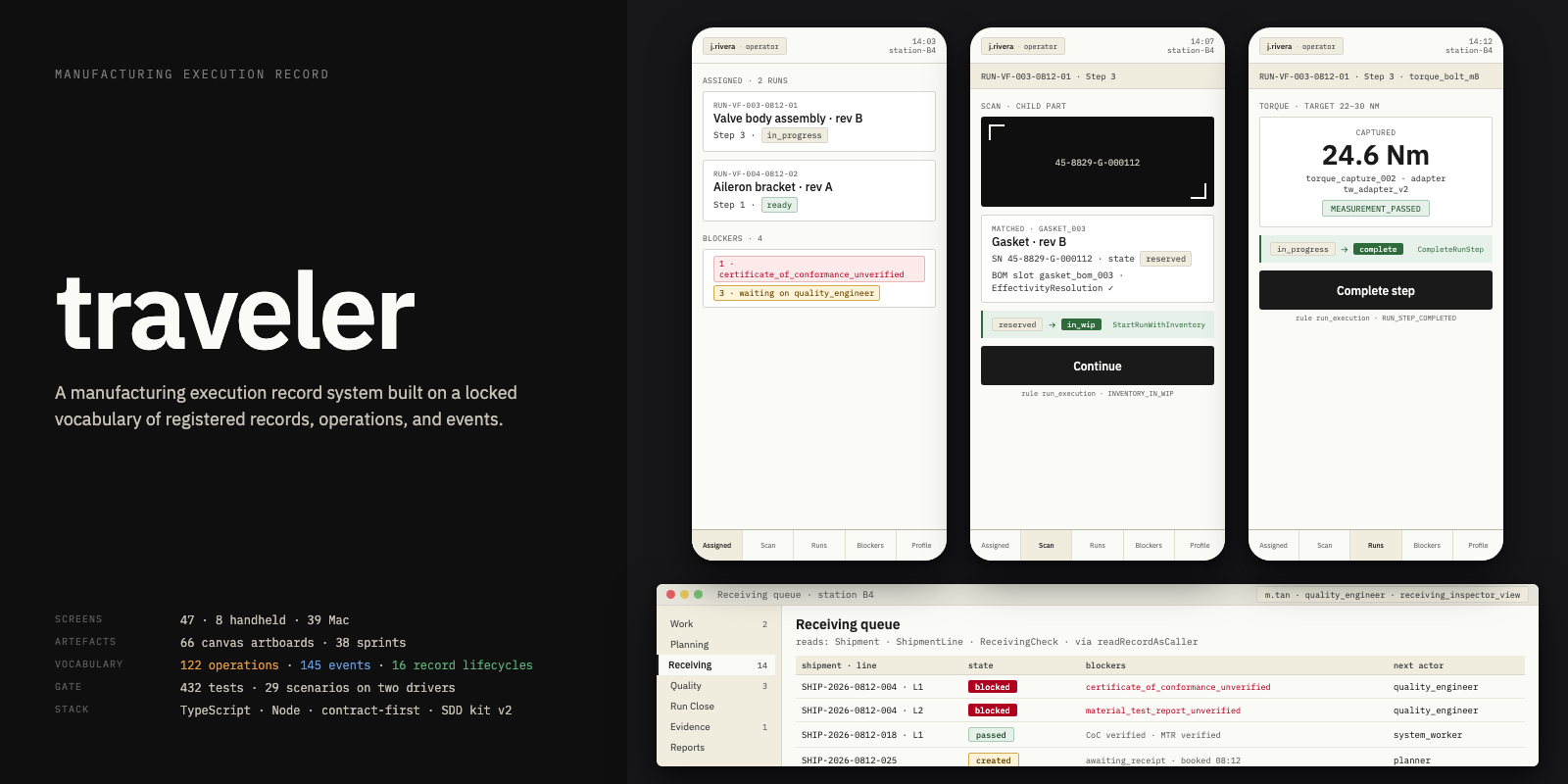
The registered surface
RECORDS · OPERATIONS · EVENTS43 record types, each declared in a single fixed contract that the runtime reads. Every field, every state, every relation lives there.
132 operations registered. Every operation the runtime accepts is declared in the contract — no unregistered call reaches a driver.
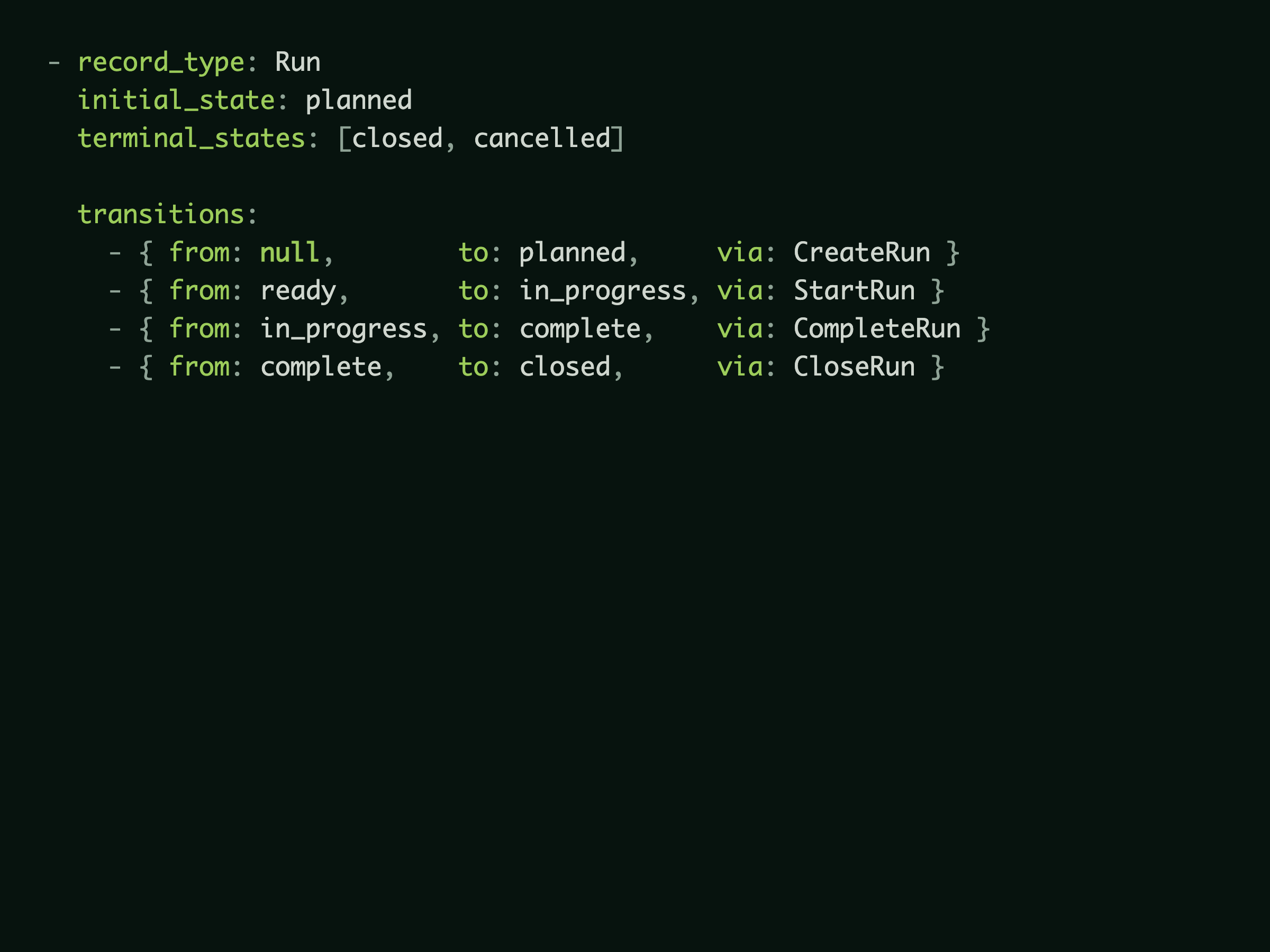
136 events, 16 state machines, 33 authorization rules. Every state change emits; the run record replays byte-for-byte on either driver (in-memory or node:sqlite).
A factory-execution system for building complex hardware. TypeScript on Node. The specifications were reverse-engineered from public sources — industry standards, published architectures, job postings, open-source projects, regulatory guidance — using Signal-Driven Development and a language model.
A prototype in TypeScript that models a manufacturing execution record system. The runtime reads a single fixed contract; each operation it runs, each event it emits, each record it holds is declared there.
No live floor UI. The design pack under canvas/ is 47 wireframes on a canvas. No device integration — scanners, printers, and machine adapters are named in the vocabulary but have no driver code. No standalone Part, Drawing, MaterialSpecification, or InspectionRequirement records. No scheduling, no MRP tie-in, no capacity model. No authentication — the caller identity is trusted at the driver boundary. No ERP integration, no other-vendor MES connection, no customer portal.
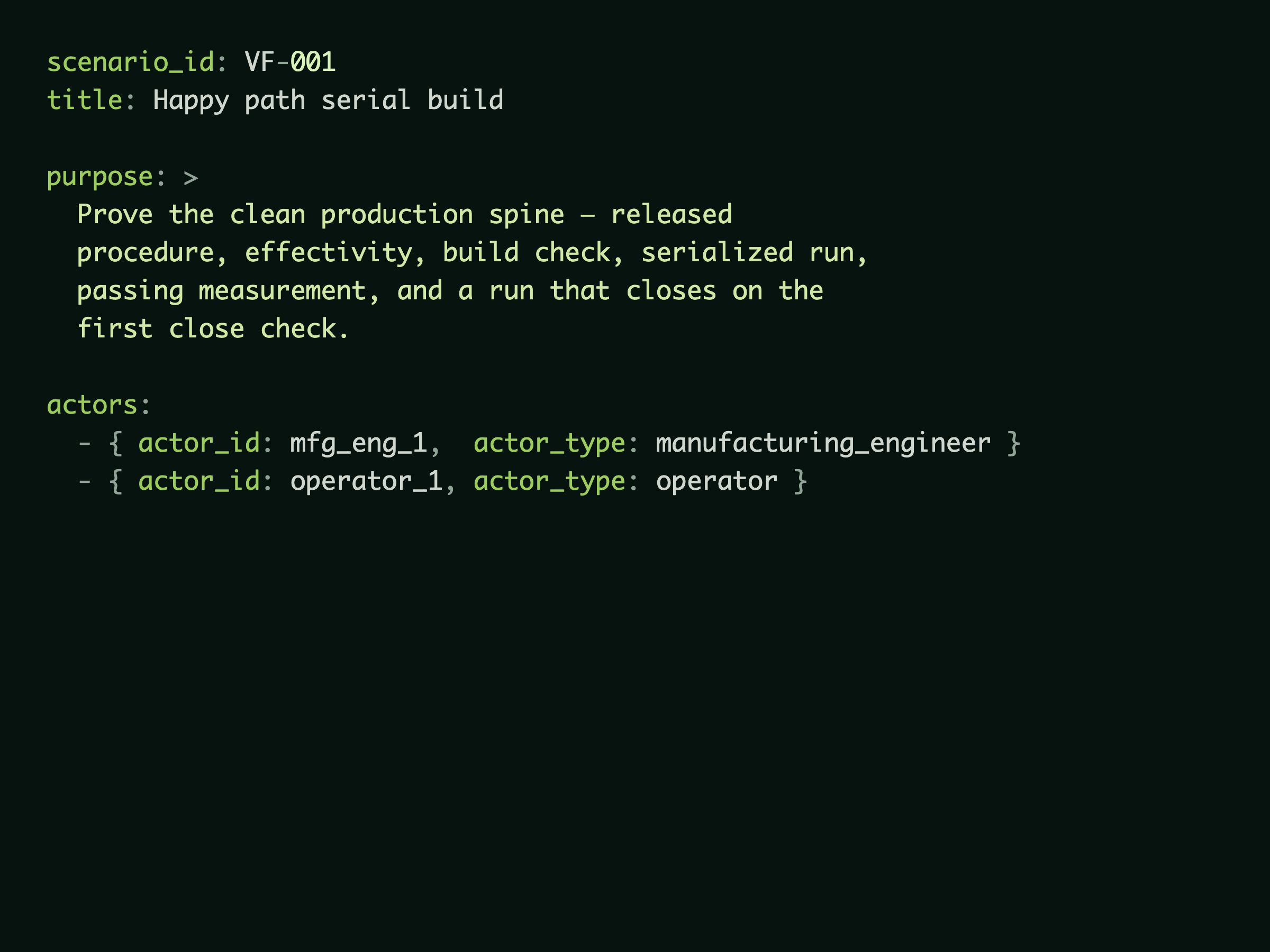
132 operations, 136 events, 43 records, 16 state machines, 33 authorization rules registered. Bench 29/29 on both drivers. Backend gate exit 0 with fifteen durability proofs. Whole-bench cross-driver check over 37 scenarios: pass. Vitest 432/432 across 58 files. Tsc 0 across src and tests.
Three governing documents closed: the nine-document founding stack, the receiving evidence boundary (15/15 §27 criteria pass), and the access and visibility boundary (18/18 §16 criteria pass or pass-in-part).