sdd-kit-2
The simplest viable Signal-Driven Development kit. Text and convention. No orchestration. Human Architect + any Tier-1 LLM.
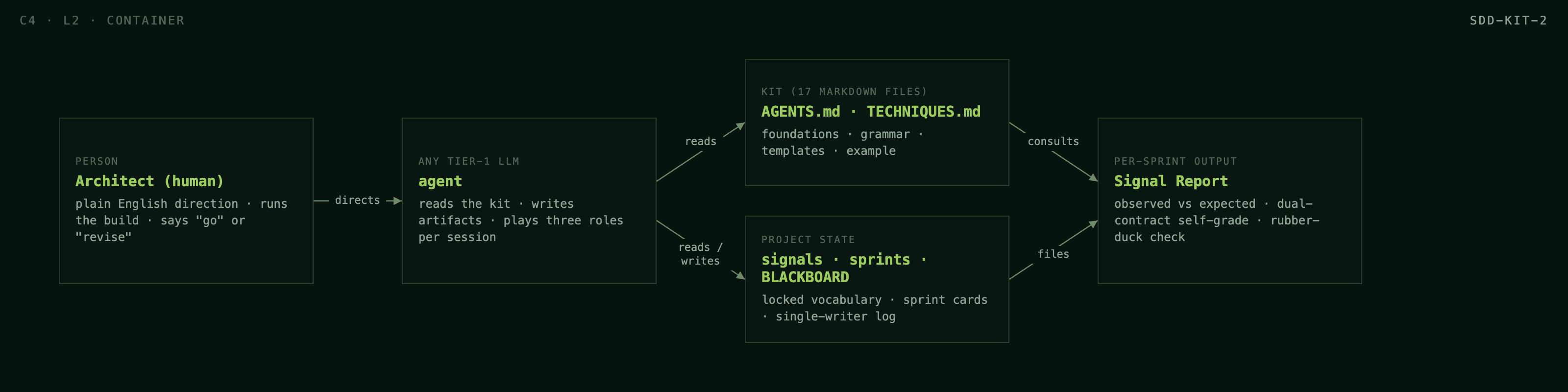
The three roles
ARCHITECT-PARTNER · SUPERVISOR · WORKERThe agent translates the human's plain-English direction into a sprint card. The human owns canonical contracts: signal vocabulary, dual contract, working agreement, the Decisions ledger.
The agent composes, dispatches itself, and self-grades. Same session, same context — no cross-process orchestrator, no queue.
The agent executes the sprint card and files a Signal Report: observed vs expected, dual-contract self-grade, citations.
Programs can emit their own state. Each event carries a category (audio, transport, layout), an uppercase tag (RECORD_START, FACE_TRAVERSE, EDGE_GRAB), and a typed payload. A model reads that stream directly and knows what the program did — the sample position, the beat position, whether quantization applied. Words are a poor medium for a frame that hitches at the end, a loop that starts on the wrong beat, a component that sits one pixel off. Signal-Driven Development is the discipline of designing that stream before the code that emits it.
sdd-kit-2 is that discipline written down. The vocabulary lives on the same design plane as the data model — named subsystems, typed payloads, a stability contract. The instrumentation ships with the code and refactors like a public API when the vocabulary changes. A person and a capable LLM read the same set of files and run the loop together.
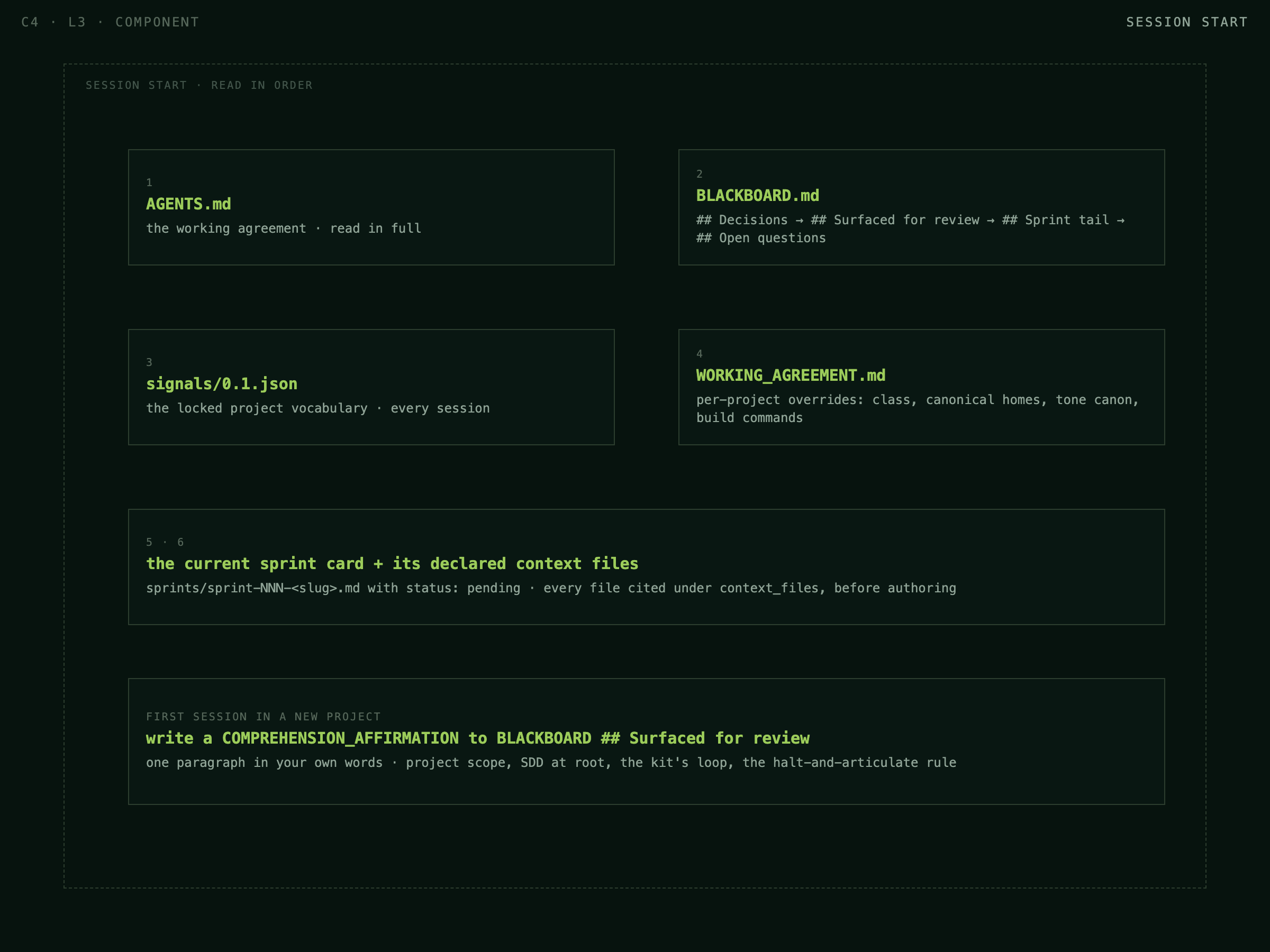
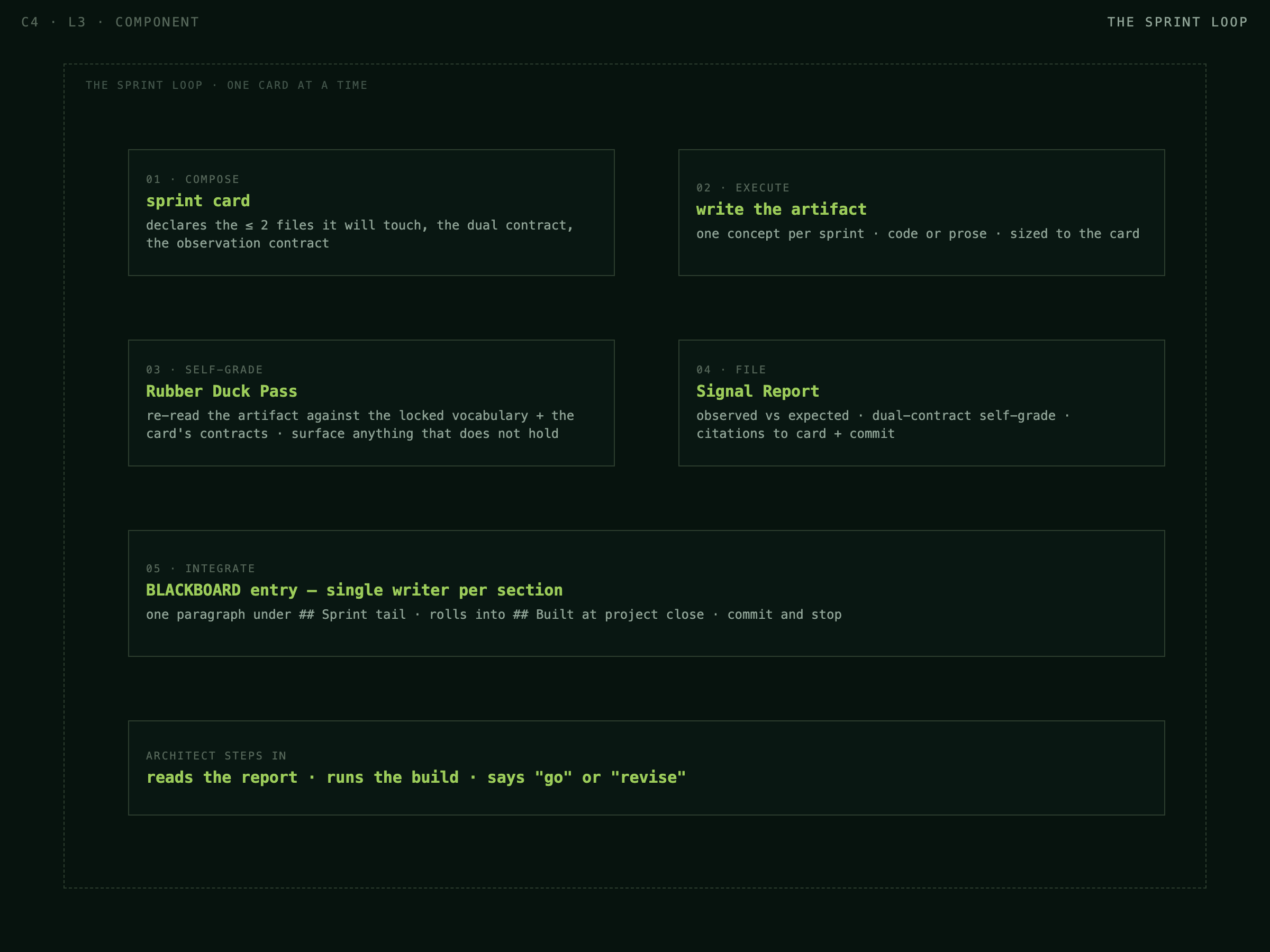
The unit of work is a sprint: a small, bounded pass whose contract is declared before the code and whose outcome is graded against the signals it was supposed to produce. Cards declare intent; reports confirm evidence; a shared board carries the audit trail forward. Hypothesis, execute, observe, integrate, next sprint.
Two roles run the loop. The human is the Architect — owner of the vocabulary, the working agreement, the decisions ledger, the build gate. The model plays three roles inside a single session: partner to the Architect on shaping the sprint, supervisor of its own execution, worker on the actual write. Session-start reading, contract grading, and the self-review are protocol encoded in files that the human and the model read the same way.
The vocabulary is the contract, locked before authoring. Signals are not logs. Description is the lossy step the kit replaces. Halt and articulate when uncertain — never silently decide. Single writer per BLACKBOARD section. No deletions: restructures land in new files, versions, or rounds.
TECHNIQUES.md is a reference catalog of named development techniques. Consult when a discipline doesn't come to hand. Not gated, not required reading every sprint.